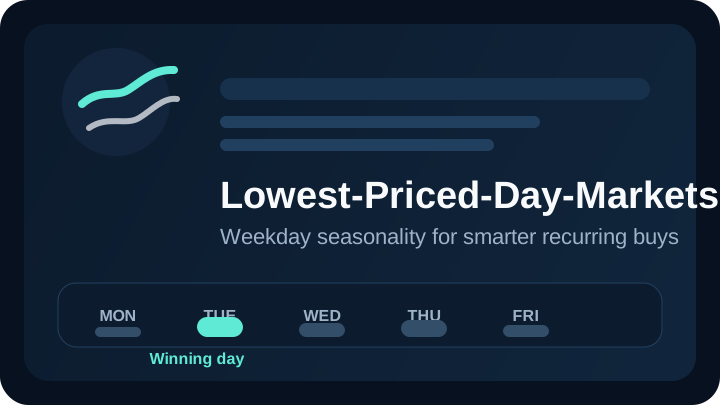
Lowest-Priced-Day-Markets
Domains

Tech Stack
Project Summary
Abstract
Lowest-Priced-Day-Markets is an analytical Streamlit application built around a focused investing question: if someone is consistently dollar-cost averaging into an ETF or stock, which trading day of the week has historically offered the lowest closing price most often? Instead of treating timing as a binary prediction problem, the app frames it as a seasonality and execution-quality question for recurring investors.
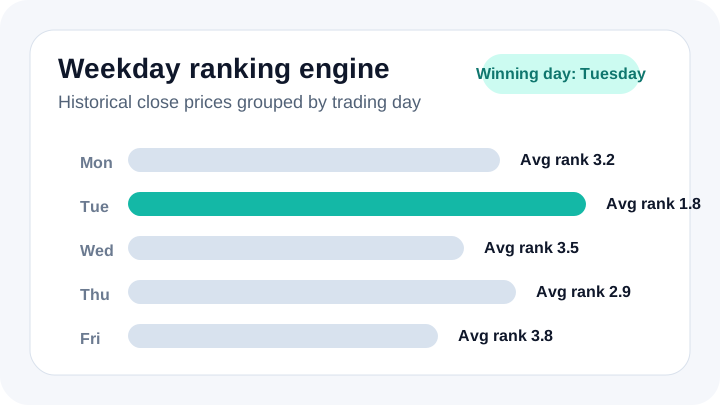
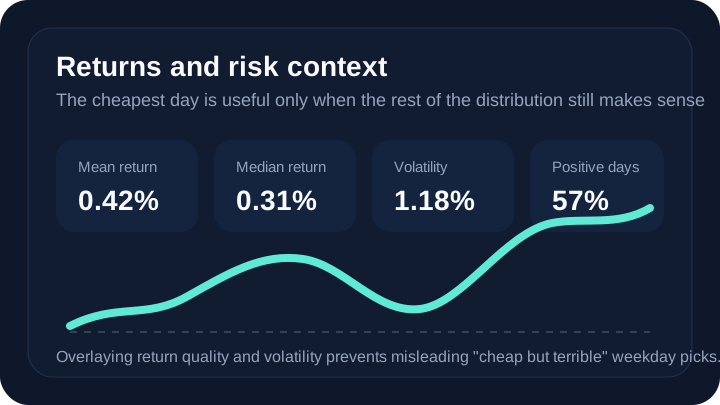
The data workflow ingests historical market prices, groups observations by weekday, and calculates which day most frequently ranks as the cheapest close. That core signal is then supported with richer descriptive statistics including average rank, mean and median daily returns, volatility, and the probability of positive returns, helping the user avoid overfitting to a single metric.
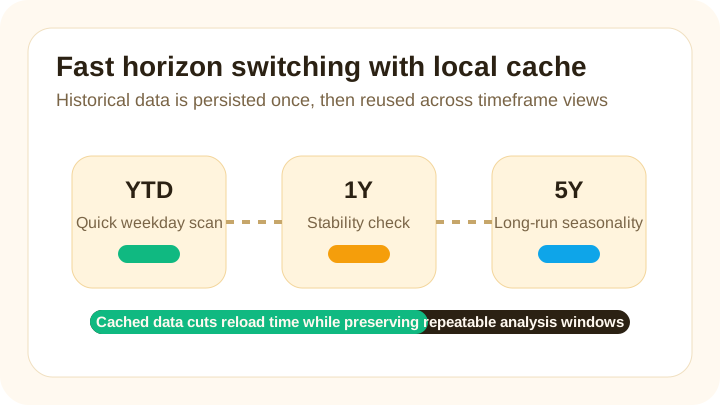
To keep the experience practical, the app also uses local CSV caching so users can explore multiple lookback windows without waiting on repeated downloads. The result is a lightweight but decision-oriented market tool for optimizing automated investment schedules with evidence instead of folklore.
What I Built
- Weekday ranking by closing-price position produced a focused seasonality signal for recurring investment schedules.
- The supporting statistics, including return profile, volatility, and positive-return odds, kept the analysis from overfitting to the cheapest day alone.
Impact
- Turned a simple investing question into an evidence-backed exploratory product for retail and systematic investors.
- Adds another finance-oriented analytics project with a clean, lightweight interface and fast iteration loop.
Page Info
Weekday Seasonality Engine
Processes historical OHLC data to rank Monday through Friday by closing-price position and surfaces the statistically strongest candidate for recurring buys or entries.
Return and Risk Breakdown
Pairs the winning-day signal with mean and median returns, volatility, positive-return probability, and average ranking so users can judge whether the cheapest day is also a sensible one.
Local Caching for Fast Time-Horizon Switching
Uses local CSV caching to avoid repeated downloads, making YTD, 1-year, and 5-year comparisons feel instant when investors explore different accumulation windows.